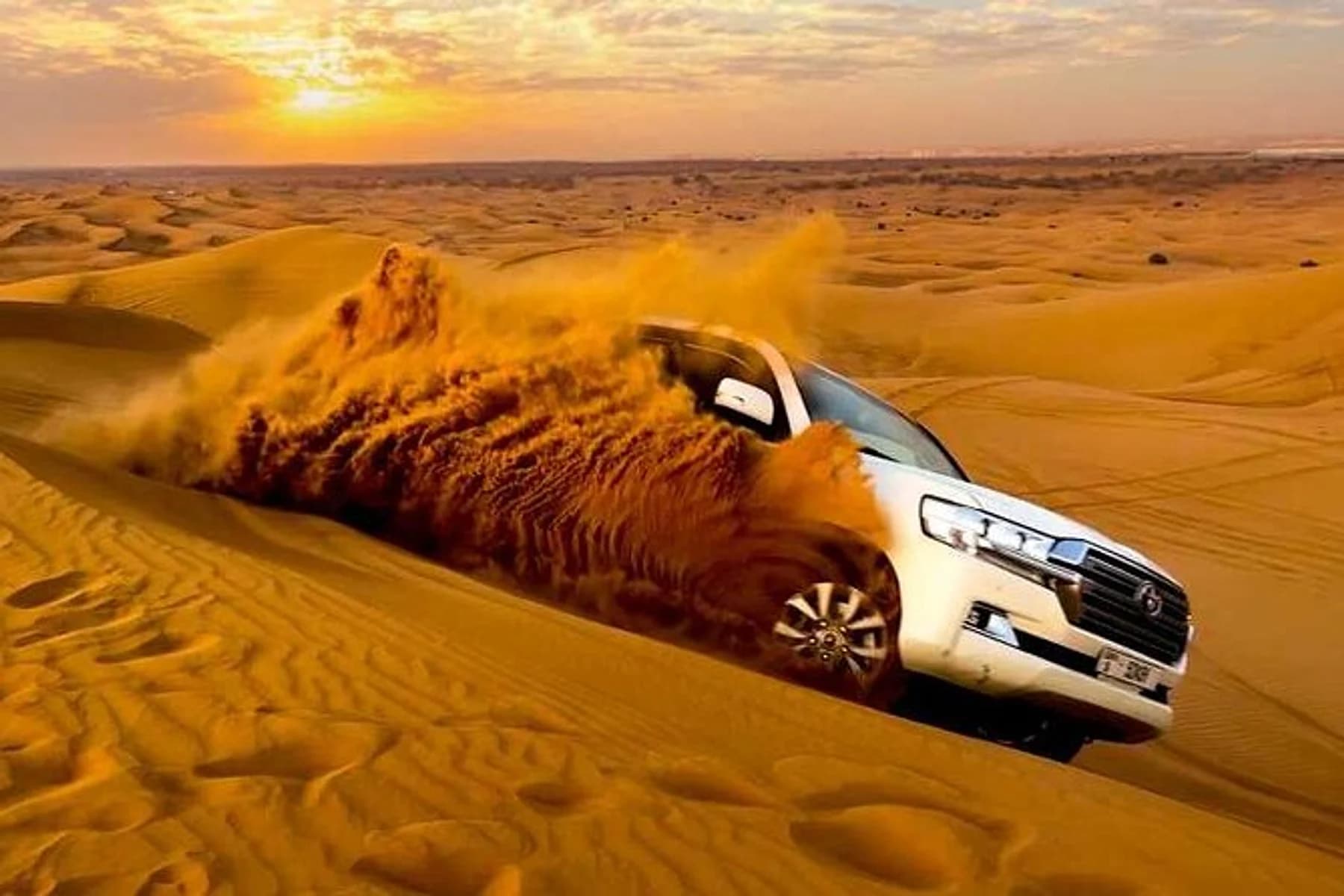
Dune bashing looks alarming in photographs, and that is rather the point of the photographs. Here is what it actually is, and where the real limits are.
What happens
A licensed driver takes a 4x4 off the tarmac at the edge of the dune field, drops the tyre pressure, and drives a route through the sand for roughly 20 to 45 minutes depending on the tour. The car climbs ridges, slides down slopes at an angle, and there is a fair amount of laughing and shrieking.
It is a rollercoaster, not a rally. The driver is not improvising — these are known routes in a known dune field, driven several times a week.
What makes it safe
Three things, and they are not complicated.
The driver. Desert driving is a specific skill and our drivers are licensed for it. The single biggest safety factor in dune bashing is whether the person at the wheel does this for a living or does it on weekends.
The vehicle. Sand-prepared 4x4s, serviced for the job, with the safety equipment they are supposed to carry.
Your seat belt. It stays fastened for the whole drive. This is the part that is genuinely on you.
Who should not do it
This is the part worth reading properly. Dune bashing is a physical activity with real forces involved, and it is not suitable for:
- Pregnant women
- Anyone with heart conditions
- Anyone with back, neck or spinal problems
- Anyone recovering from surgery
If that describes someone in your group, it does not mean they miss the evening. Tell us when you book and we arrange a direct transfer to the camp — they arrive before the rest of you, with a drink, and they get the sunset, the dinner and the shows without the drive through the dunes.
That option costs nothing extra. It just needs to be arranged in advance rather than mentioned in the car park.
Motion sickness
If you get carsick, the dunes will find out. Two things that help: sit in the front if you can, and do not eat a heavy meal beforehand — dinner is at the camp anyway, around 7:30 PM.
And say something at the start. Which brings us to the useful part.
You can just ask for less
The thing most guests do not realise is that the intensity is adjustable, and the driver would much rather know at the beginning than find out from the back seat.
Tell him at the start of the drive that you would like it gentler, and he takes a softer line — flatter routes, shallower angles, no sharp descents. It is still the desert and still worth doing. Nobody is disappointed by this and nobody is judging.
On a Private Desert Safari you have the whole vehicle to yourselves, which makes this easier again: the drive is shaped around your group from the start rather than negotiated with strangers.
Children and older guests
Children ride the dunes all the time and generally love it. Very young children, and older guests who would find the jolting uncomfortable, are better off on the gentler route or the direct camp transfer.
We have written more about that in taking children and grandparents on a safari.
Quads and buggies
Different risk, different answer. On a quad bike or a buggy you are the driver. You get a briefing, a helmet, goggles and a marshal who rides with the group, and you ride within your own limits. Riders need to meet the minimum age and be sober.
The honest framing: dune bashing is something that happens to you and is managed by a professional. A quad is something you do, and your own judgement is part of the safety equipment.
If you have a specific medical worry, message us before booking rather than after. It is a two-minute conversation and it usually ends with a plan that works.